What Is Industrial Floor Repair Mortar?

Industrial Floor Repair Mortar is a cementitious or resin-based material designed to restore damaged concrete floors. It can fill spalls, rebuild worn edges, and smooth shallow depressions. The right product helps forklifts roll more evenly and reduces places where dirt collects. But mortar is not magic.

Concrete-repair author Peter H. Emmons has written about practical repair principles. A concise paraphrase of that approach is: “A durable repair depends on sound preparation as much as the repair material.” This is a paraphrase, not a verified verbatim quotation. In practice, workers remove loose concrete, clean dust and oil, and check the repair depth before placing mortar. They also consider curing time, traffic, moisture, and the floor’s existing condition. A loading bay exposed to pallet jacks may need different performance than a lightly used workshop aisle.

This article explains what Industrial Floor Repair Mortar is, where it is used, and how to assess a suitable type. It also looks at preparation, application, and common limitations. Small details matter. A cold slab or rushed cure can weaken an otherwise careful repair. Product labels help, but site conditions still deserve a close look. Sometimes the damage points to a deeper problem, such as ongoing moisture or movement. Repairing the surface alone may not solve it. That is easy to overlook.
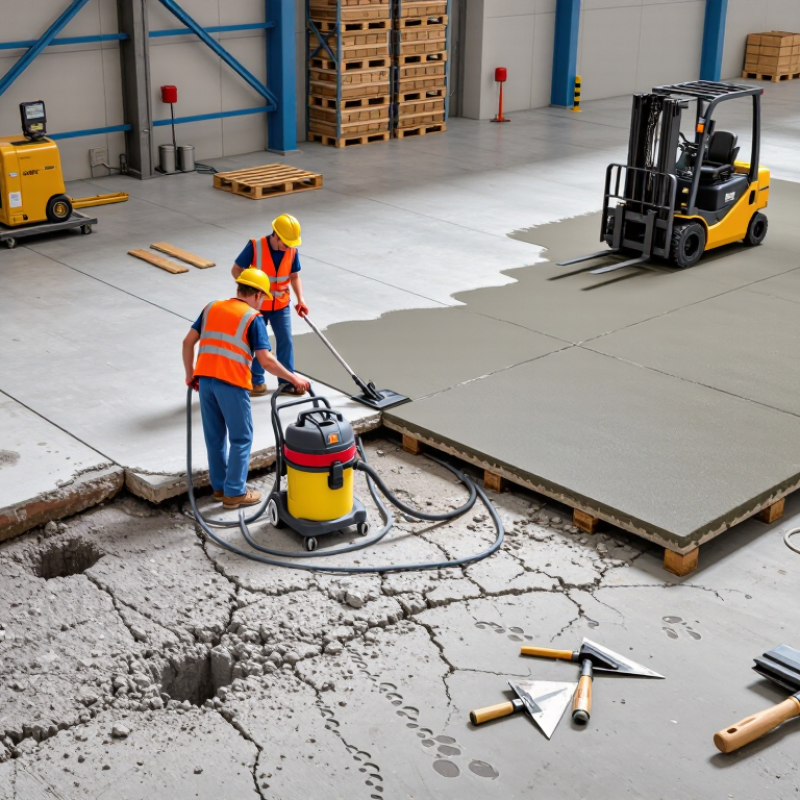
What Is Industrial Floor Repair Mortar?

How Industrial Floor Repair Mortar Is Defined

What Is Industrial Floor Repair Mortar?

How Industrial Floor Repair Mortar Is Defined

Industrial floor repair mortar is a formulated material used to restore damaged concrete in working environments. It typically contains cementitious binders and graded aggregates, and may include polymers or fibers. Unlike ordinary patching mortar, it is selected for the repair’s depth, substrate condition, curing window, and expected traffic. A forklift wheel crossing a chipped loading-bay edge is a useful example: the patch must bond to sound concrete and tolerate repeated loading. The term is broad, though. Not every repair mortar is suitable for every floor.

A useful technical benchmark is EN 1504-3:2005, which classifies concrete repair products by performance. Its R3 class specifies a minimum compressive strength of 25 MPa and bond strength of 1.5 MPa; R4 requires 45 MPa and 2.0 MPa. These figures help define performance, not guarantee suitability for a particular site. Floor selection also depends on abrasion, chemical exposure, repair thickness, and downtime. Strength alone can mislead.

Tips: Check the product’s technical data sheet for approved thickness, substrate preparation, and traffic-opening time. Remove weak concrete and dust before placement. A rushed repair may look sound, yet fail at the bond line. Verify the required profile and curing conditions on site.

What Materials Are Used in Industrial Floor Repair Mortar

What Is Industrial Floor Repair Mortar?

What Materials Are Used in Industrial Floor Repair Mortar

Industrial floor repair mortar is a formulated material for patching damaged concrete in working environments. Its ingredients vary with the repair depth, traffic, and exposure conditions. Cement-based products commonly contain Portland cement and graded sand or other mineral aggregates. The aggregate gives the mortar body and helps control shrinkage. Polymer modifiers can improve adhesion and flexibility. Small fibers may help limit cracking, though they cannot replace sound preparation or proper curing.

Some formulations also include silica fume, accelerators, or water-reducing additives. These ingredients can affect strength development, flow, and working time. Resin-based repair materials use different chemistry, such as epoxy, and may suit specific chemical or bonding requirements. They are not interchangeable with cement-based mortar. Check the product’s technical data for compatible substrates, application thickness, and service conditions. One detail is easy to overlook: even a strong mix can fail on dusty, oil-stained, or weak concrete.

Tips: Remove loose concrete and clean the repair area before mixing. Follow the stated water ratio and curing instructions; extra water can weaken the patch. Test a small area when conditions are unusual. That step takes time, but skipping it can be costly.

What Is Industrial Floor Repair Mortar? – What Materials Are Used in Industrial Floor Repair Mortar?

Material or component Typical role in the mortar Common properties Where it is commonly used
Portland cement Acts as the main hydraulic binder in many cementitious repair mortars. Sets and hardens when mixed with water; provides compressive strength and a mineral-based repair surface. Concrete floor patches, spall repairs, and general-purpose repairs where a cement-based system is suitable.
Polymer modifiers Improve the bond and handling characteristics of cement-based mortars. May improve adhesion, flexibility, and resistance to water or abrasion; performance depends on the formulation. Thin repairs, vertical edges, and areas where improved adhesion to prepared concrete is needed.
Graded silica or other mineral aggregates Provide bulk, contribute to strength, and help control the repair layer’s texture and thickness. Particle size and grading affect workability, surface finish, and suitability for shallow or deeper repairs. Most cementitious and resin-based repair mortars; aggregate selection should match the repair depth and service conditions.
Epoxy resin and hardener Form a resin binder in two-component epoxy repair systems. Can provide strong adhesion and good resistance to many chemicals; mixing ratios and working time are product-specific. Repairs requiring high bond strength or chemical resistance, when the substrate and exposure conditions are appropriate.
Polyurethane resin Serves as the binder in certain resin-based repair systems. Some formulations offer greater flexibility than rigid resin systems and can accommodate limited movement. Selected repairs where flexibility or particular exposure performance is required; suitability depends on the formulation.
Methyl methacrylate (MMA) resin Acts as a fast-curing binder in specialized repair mortars. Can cure rapidly, including at relatively low temperatures; requires careful handling and ventilation during application. Time-sensitive repairs where a short return-to-service window is important and site conditions allow its use.
Fibers Help control plastic shrinkage cracking and improve cohesion in some formulations. May include synthetic or mineral fibers; do not replace correct joint detailing or substrate preparation. Selected patching and repair mixes, depending on the required crack-control and placement properties.
Performance additives Adjust setting time, flow, water demand, air content, or other application properties. Examples include water reducers, accelerators, retarders, and thickeners; their effects depend on dosage and compatibility. Formulated into repair mortars to suit placement methods, ambient conditions, and required setting behavior.

Note: Industrial floor repair mortar is a formulated repair material, not a single fixed recipe. The appropriate binder and aggregate system depend on repair depth, substrate condition, chemical exposure, traffic, temperature, and required return-to-service time. Always follow the product technical data sheet and prepare the concrete as specified.

Which Types of Industrial Floor Repair Mortar Are Available

Industrial floor repair mortar is chosen by matching its chemistry and setting speed to the damage, traffic, and downtime. Cement-based mortars suit chipped edges, shallow spalls, and localized slab repairs. Polymer-modified cement mortars add adhesion and toughness where ordinary patching mixes may debond. ASTM C928/C928M evaluates rapid-hardening cementitious repair materials using performance tests, including compressive strength and length change. Check the product data against the required reopening time; “fast-setting” does not mean ready for forklift traffic immediately.

Epoxy mortars combine resin and graded aggregate, making them useful for deep, load-bearing patches and chemical exposure. Polyurethane or other resin systems can suit areas needing flexibility, though moisture and temperature affect installation. Small patch. Big risk. ICRI Guideline 310.2R defines ten concrete surface-profile grades, CSP 1 through CSP 10; the needed profile depends on the repair system and bond requirements. A smooth, dusty cut edge can undermine even a strong mix. I would not select by strength alone: cure time, thermal movement, wet cleaning, and the wheel path all matter. Product labels can also blur the line between mortar and resin coating, so verify the technical data sheet before specifying a repair.

What Is Industrial Floor Repair Mortar?

Common Types and Typical Compressive Strength Ranges

Industrial floor repair mortar is a material used to patch or rebuild damaged concrete floors. Cementitious, polymer-modified, rapid-setting cementitious, and epoxy mortars are common options. The ranges shown are indicative examples in MPa; actual strength depends on the formulation, curing conditions, and manufacturer specifications.

What Floor Damage Industrial Repair Mortar Can Address

What Is Industrial Floor Repair Mortar?

What Floor Damage Industrial Repair Mortar Can Address

Industrial repair mortar can restore localized damage that interrupts safe, routine floor use. It is commonly used for shallow spalls, chipped edges, small cracks, and surface pits caused by dropped tools, wheeled loads, or repeated traffic.

Picture a rough patch beside a loading bay where pallet-jack wheels catch and shed more concrete. A properly selected mortar can fill the damaged area and create a more even surface.

It can also repair worn spots where the surface has become powdery or uneven. In some settings, suitable formulations can withstand contact with oils, cleaning agents, or other mild chemicals. Suitability depends on the product’s stated resistance and the exposure conditions. Preparation matters: loose concrete, dust, and residue can weaken the bond, even when the repair looks smooth at first. Small details count.

Mortar is not a cure for every floor problem. A crack that keeps widening, a section that moves under load, or damage linked to ongoing moisture may need investigation before patching. Otherwise, the repair could fail again. That is frustrating, and easy to overlook. Assessing the damage, load, and likely cause helps determine whether a local mortar repair is appropriate or whether deeper repair work is needed.

How Industrial Floor Repair Mortar Is Selected and Applied

Industrial floor repair mortar is a cementitious or resin-modified material used to restore worn, cracked, or spalled concrete. Selection starts with the damage, not the bag label. A shallow chip near a doorway needs different handling from a deep, oil-contaminated trench under a forklift route. Check the repair depth, moisture exposure, chemical contact, expected traffic, and required reopening time. ACI 546R-14, Guide to Concrete Repair, emphasizes matching repair materials to the substrate and service conditions.

Preparation often decides whether a repair lasts. Remove unsound concrete until the edges are firm, then clean away dust, grease, and loose particles. ICRI 310.2R-2013 describes ten concrete surface profile grades, CSP 1 through CSP 10; the specified profile should suit the repair system. Details matter. Follow the mortar’s technical data for mixing water, working time, minimum and maximum thickness, and curing. A patch that looks smooth may still fail if it bridges a weak edge or dries too quickly.

Before application, confirm the slab is sound and the repair area is properly shaped. Place and compact mortar firmly, especially at corners and around drains, then finish without adding excess water. Keep forklifts off until the stated cure or traffic-return time is reached. One uncomfortable truth: no mortar can rescue a moving slab or ongoing water leak. Site conditions can be messy, and moisture readings may not tell the whole story, so verify the cause before patching.