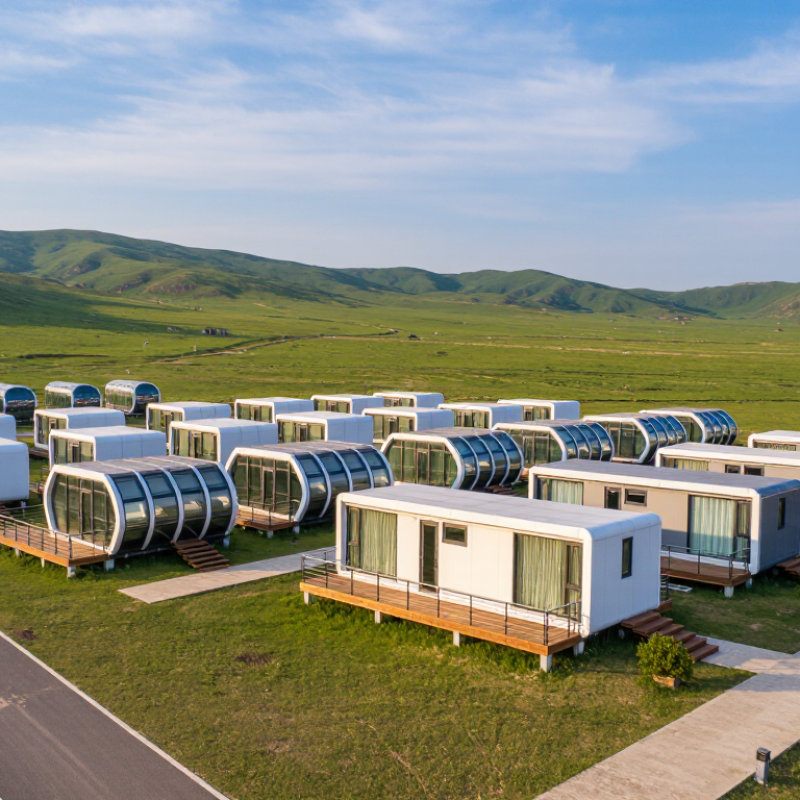
China has become a major sourcing destination for buyers seeking reliable Capsule Cabin solutions. Its manufacturers offer compact hotel pods, mobile cabins, glass cabins, and modular units for resorts, campsites, and remote destinations. However, supplier selection requires more than attractive photographs and competitive prices.
Kisho Kurokawa, a leading capsule-architecture theorist, described the capsule as “a replaceable unit.” This idea remains highly relevant today. A modern Capsule Cabin should support practical replacement, repair, relocation, and future upgrades. Buyers should examine factory experience, structural materials, insulation performance, waterproofing details, electrical systems, and production quality controls. Ask for factory videos, material specifications, inspection records, and completed project references.
Small details matter.
A well-built cabin should close securely during heavy rain. Its floor should remain stable after repeated transport. Wall insulation should suit the destination’s climate, not only the showroom’s temperature. Buyers must also confirm packaging methods, installation guidance, spare parts, warranty coverage, and after-sales communication. Local building, fire, electrical, and transport requirements should be checked before ordering.
This guide introduces several China-based Capsule Cabin manufacturers for global buyers. It compares their product categories, customization abilities, manufacturing strengths, and service capabilities. Some suppliers may look highly professional online, yet their real delivery performance still needs verification. That is an uncomfortable point, but an important one. Factory audits, independent inspections, and clear contracts can reduce avoidable risks. The goal is not simply to find the lowest quotation. It is to identify a manufacturer capable of delivering safe, durable, attractive, and commercially practical cabins.
China Top Capsule Cabin Manufacturers for Global Buyers?
UN Tourism reported about 1.4 billion international tourist arrivals in 2024. This recovery is reshaping demand for compact accommodation near airports, rail stations, scenic areas, and busy urban districts. Capsule cabins offer a practical response where floor space is limited and overnight privacy matters.
Experienced buyers should examine more than the cabin’s appearance. They need verified material specifications, fire-safety documentation, ventilation performance, acoustic control, and clear installation procedures. A reliable manufacturer should provide factory inspection records, sample testing, spare-parts guidance, and stable production capacity. Ask about bed dimensions, lighting controls, luggage storage, cleaning access, and emergency exits. Small details affect guest reviews.
A useful factory visit can reveal workmanship that photos hide. Inspect door seals, welded joints, wiring protection, and the quality of interior panels. Request a trial unit before placing a large order. It exposes problems early.
Not every compact design suits every market. Humid coastal locations may require stronger corrosion resistance. Cold regions need better insulation and heating planning. Regulations also differ between countries and cities, so local professionals should review the layout before installation. Some buyers focus too heavily on the purchase price. That can become expensive later through maintenance, shipping changes, or difficult replacement work. Even careful sourcing is imperfect. Production schedules may shift, and specifications can be misunderstood without written approval drawings. Reliable communication remains as important as manufacturing skill.
Selecting China’s top capsule cabin manufacturers requires more than comparing showroom photos. Quality should lead the ranking. ISO 9001 certification helps, but it does not replace factory audits. Check weld penetration, waterproof testing, insulation thickness, fire-rated materials, and electrical documentation. The International Energy Agency reports that buildings consume about 30% of global energy. Therefore, thermal performance matters, especially for cabins shipped to cold or hot regions. Request test records, not promises.
Capacity must mean repeatable production, not a crowded workshop. Ask for audited monthly output, current order queues, rejection rates, and average lead times. Customization deserves separate scoring. Strong manufacturers can adjust layouts, glazing, bathrooms, ventilation, and furniture without weakening the structural frame. However, excessive customization may increase engineering errors and spare-part costs. I would score documented design control higher than attractive computer renderings. Export experience also matters. Review packing photographs, container-loading plans, installation manuals, and destination-country compliance files. UN Comtrade data shows China remains a major global manufacturing exporter, but export volume alone proves little about cabin reliability.
Tips: Request one finished-unit inspection before mass production. Use a checklist with photographs. Ask how damage claims were handled. A practical ranking should also include after-sales response time, replacement-part availability, and payment milestones. Some manufacturers may provide impressive data, yet fail to explain one delayed shipment. That weakness is worth recording. Good evaluation is never perfectly objective; local climate, transport distance, and installation skills can change the final result.
China’s capsule cabin manufacturers are attracting global buyers through modular construction. Factory-built units arrive with walls, wiring, insulation, and bathroom modules largely completed. This approach can reduce site labor and simplify quality checks. McKinsey reports that modular methods may cut project timelines by up to 50%. The figure is possible, not guaranteed.
The strongest schedule gains appear when designs are standardized early. A buyer can approve one cabin layout, repeat it, and order components in batches. While production continues indoors, foundations and utility connections can proceed on site. A typical project manager tracks shop drawings, inspection photos, packing lists, and container loading dates. These records create accountability across different time zones.
However, speed can expose weak planning. Custom changes after production begins may cause costly delays. Local fire rules, wind loads, insulation requirements, and electrical standards also need technical review. An experienced supplier should provide material specifications, structural calculations, installation guidance, and clear warranty terms. Factory visits or independent inspections add useful evidence. They do not replace professional judgment. Buyers should compare the promised timeline with port clearance, local assembly, and weather risks. Fast delivery sounds attractive. Real reliability comes from controlled details, not optimistic schedules.
Selecting a capsule cabin manufacturer in China requires more than polished photographs. Factory due diligence should begin with ISO 9001 evidence. Request the certificate, issuing body, validity dates, and covered production site. Compare these details with internal quality records, including material checks, welding inspections, and water-leak tests. A certificate alone is not proof. Its scope may exclude the cabin line you intend to purchase.
Walk through the workshop, not only the showroom. Count active assembly stations, welding bays, curing areas, and finished units awaiting dispatch. Ask for monthly output during the past six months, rather than an optimistic maximum. Review staffing levels, lead-time data, and purchase records with sensitive information removed. Capacity claims can change quickly. One overlooked bottleneck, such as window supply, may delay an entire batch.
For 20-foot and 40-foot shipments, confirm cabin dimensions, folded components, gross weight, and loading diagrams. Ask whether units require flat-rack, open-top, or standard containers. Measure door clearance and check lashing points before production. Request packing photos from a recent shipment. Small errors become expensive at the port. An independent pre-shipment inspection can verify quantities, workmanship, and packaging. I would also test one pilot unit before scaling, because drawings rarely reveal every installation problem. Keep inspection criteria signed by both parties.
Factory Due Diligence: ISO 9001, Production Capacity, and 20-/40-Foot Logistics
China’s capsule cabin manufacturers serve buyers across hotels, resorts, offices, and temporary accommodation projects. Global buyers should inspect compliance before comparing prices. EN 13501-1 classifies reaction to fire, including wall panels, insulation, flooring, and ceiling materials. Ask for recent laboratory reports that identify exact materials and thicknesses.
A report is not automatically a complete cabin approval. Request sample references, production records, and batch traceability. Paperwork matters. Check whether testing came from a competent, independent laboratory. The report should match the delivered product, not an older prototype. Fire performance can change after decorative films, adhesives, or cable openings are added.
CE marking requires careful review. It applies only when relevant European Union requirements cover the finished product or its components. Ask for the Declaration of Conformity, technical documentation, and evidence for electrical safety and electromagnetic compatibility. A CE mark is not a universal quality certificate. It also does not replace local installation rules.
For 230V/50Hz systems, verify the incoming supply, protective earthing, circuit breakers, socket types, cable sizes, and appliance ratings. Request wiring diagrams and an electrical inspection record. Test one completed cabin under realistic load conditions. Small details matter. A supplier may provide a compliant control panel but use unsuitable extension wiring inside the cabin. That mistake is easy to miss during a factory visit. Manufacturers should welcome independent inspection, though buyers should still question unclear documents and inconsistent labels.
| Compliance Area | Applicable Requirement or Reference | Key Technical Data | Evidence to Request from the Supplier | Buyer Verification Point | Status |
|---|---|---|---|---|---|
| Reaction to Fire | EN 13501-1:2018 or the edition specified by the project or authority | European reaction-to-fire classes include A1, A2, B, C, D, E and F. Smoke production is rated s1, s2 or s3, while flaming droplets are rated d0, d1 or d2 where applicable. | Valid classification report or certificate identifying the tested product, construction build-up, thickness, substrate and installation method. | Confirm that the report covers the actual wall, ceiling, floor, insulation, coating, adhesive and decorative finish used in the cabin. A report for one assembly does not automatically cover another assembly. | Project-dependent |
| Fire-Test Sample Traceability | Product-specific testing and documented material traceability | Fire performance depends on the complete assembly, including joints, cavities, insulation, surface layers and fixing details. | Material list, technical drawings, batch records, test photographs and a declaration that production materials match the tested construction. | Check whether later substitutions, thinner panels or different interior finishes invalidate the original fire classification. | Required for credible verification |
| CE Marking Applicability | CE marking is required only when the finished product or incorporated equipment falls under applicable European Union harmonisation legislation. | CE marking is not a universal quality mark and does not automatically certify the entire cabin. The applicable legislation depends on the product configuration and intended use. | EU Declaration of Conformity listing the responsible economic operator, applicable legislation, product identification and relevant standards. | Verify that the declaration describes the supplied product and is signed by an authorised responsible person. Do not accept a generic CE logo as sole evidence. | Conditional |
| Low Voltage Electrical Safety | Directive 2014/35/EU may apply to electrical equipment rated between 50 and 1,000 V AC or 75 and 1,500 V DC, subject to scope. | A 230 V AC cabin supply falls within the stated AC voltage range of the Low Voltage Directive when the equipment is within its scope. | Electrical risk assessment, wiring diagram, component specifications, inspection records and an EU Declaration of Conformity where applicable. | Confirm protection against electric shock, correct conductor sizing, protective earthing, enclosure suitability and safe access to electrical components. | Conditional |
| Electromagnetic Compatibility | Directive 2014/30/EU may apply to electrical and electronic equipment placed on the EU market. | Lighting drivers, power supplies, ventilation controls, displays and smart-control modules can create or be affected by electromagnetic disturbance. | EMC test report or technical documentation covering the installed electrical and electronic configuration. | Check that the tested configuration matches the supplied control systems, cable routing, power supplies and connected devices. | Conditional |
| Nominal Supply Voltage | Destination-country electrical supply requirements | 230 V AC is the nominal low-voltage supply used across much of Europe and several other markets. Actual permitted voltage tolerances depend on the local grid standard and installation rules. | Electrical nameplate, wiring diagram, power-consumption schedule and installation manual. | Confirm whether the cabin requires a dedicated circuit and whether appliances, sockets, heating and air-conditioning are rated for the destination supply. | Must match destination |
| Nominal Frequency | Destination-country electrical frequency requirements | 50 Hz is the nominal frequency used with 230 V systems in many target markets. Motors, pumps, fans and compressors must be suitable for the specified frequency. | Appliance data sheets, motor nameplates and a complete load schedule showing voltage and frequency. | Do not rely only on the cabin inlet label; verify every fixed appliance and control component for 230 V/50 Hz operation. | Must match destination |
| Protective Earthing and Bonding | Applicable national wiring regulations and the destination-country installation code | All exposed conductive parts requiring protection should be connected to the protective-earth system in accordance with the applicable installation rules. | Earthing diagram, continuity-test records, terminal details and installation instructions for incoming power. | Verify the protective-earth conductor, bonding of metal frames and the location of the main isolation device. | Required |
| Residual-Current Protection | Destination-country electrical installation requirements | Residual-current device requirements, including rated residual operating current and device type, depend on the final installation and connected loads. | Recommended protective-device schedule and a clear statement of which protective devices are supplied with the cabin and which are provided on site. | Have the final protection design reviewed by a qualified electrician in the destination country, especially where bathrooms, outdoor connections or wet areas are present. | Installation-dependent |
| Ingress Protection | IEC 60529 classification where an IP rating is claimed | IP ratings describe protection provided by an enclosure against solid objects and water under defined test conditions. The rating must be assigned to a specific enclosure or assembly. | IP test report or component documentation identifying the tested enclosure, configuration and mounting conditions. | Confirm that cable glands, doors, vents, sockets and service penetrations maintain the claimed protection level after installation. | Recommended where relevant |
| Electrical Documentation | Technical construction file and destination-country installation requirements | Documentation should identify incoming supply, maximum demand, circuit protection, cable sizes, isolation points, equipment ratings and connection details. | Single-line diagram, wiring schematic, terminal schedule, load calculation, user manual and maintenance instructions. | Check that documents are supplied in a language accepted by the destination authority or project owner and correspond to the final production model. | Required for safe installation |
| Mechanical and Structural Scope | Local building, transport, foundation, wind, snow and seismic requirements | EN 13501-1 addresses reaction to fire; it does not by itself prove structural capacity, weather resistance, transport strength or building-code compliance. | Structural drawings, design loads, connection details, lifting points, anchoring instructions and relevant engineering calculations. | Have a local engineer confirm suitability for the site, foundation, climate, occupancy classification and intended method of installation. | Site-dependent |
| Ventilation and Indoor Environment | Destination-country ventilation, indoor-air-quality and moisture-control requirements | Airflow capacity, fresh-air rate, extraction route, condensation control and filtration should be specified for the intended occupancy and climate. | Fan performance curve, ventilation layout, noise data, filter specification, condensate-management details and maintenance schedule. | Confirm that ventilation performance is stated at the installed pressure, not only as an unloaded fan rating. | Project-dependent |
| Pre-Shipment Acceptance | Contract-specific inspection and quality-control plan | Recommended checks include dimensional inspection, visual finish review, functional testing, electrical safety checks, appliance operation and document verification. | Signed inspection checklist, test records, photographs, packing list, serial or batch traceability and outstanding-defect register. | Make acceptance criteria, permitted tolerances, corrective-action deadlines and responsibility for re-testing part of the purchase contract. | Recommended |