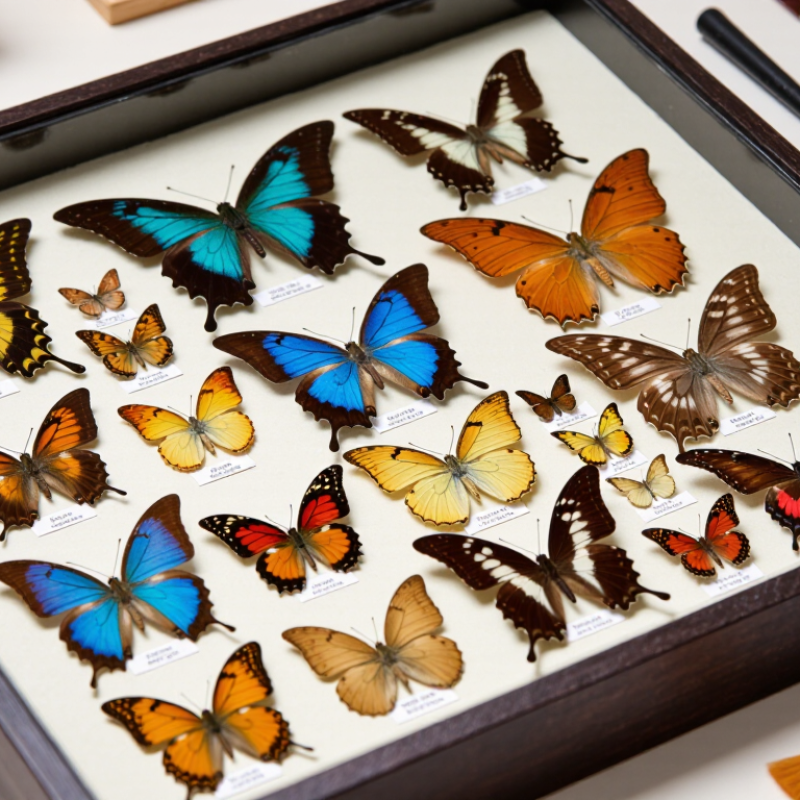
The most useful Butterfly Specimen collections in 2026 are defined by accurate identification, clear provenance, and careful preservation—not by rarity alone. Common groups include swallowtails, brush-footed butterflies, skippers, and regional native species, each offering distinct wing shapes, colors, and identification challenges. Small details matter: a label recording the collection location and date can be as informative as a vivid blue wing.
Professional conservation data adds necessary context. The 2019 IPBES Global Assessment reported that around one million animal and plant species face extinction, many within decades, unless pressures on nature are reduced. That finding is not a market forecast, but it is a reason to assess sourcing carefully. Robert Watson, then chair of IPBES, said, “Nature is declining globally at rates unprecedented in human history.” His warning concerns biodiversity broadly, including the ecosystems butterflies depend on. Check current local requirements and supplier documentation before acquiring specimens; rules and conservation status can vary by species and place.
This guide compares specimen types by visual character, educational value, and practical care. It also considers a less glamorous question: what does a beautiful display leave out? A specimen can teach taxonomy, yet it cannot show a living butterfly’s behavior or habitat. That tension deserves attention.
What Are the Top Butterfly Specimen Types in 2026
Global Taxonomy: About 18,000 Butterfly Species Inform Specimen Selection
Taxonomic references place known butterfly diversity at roughly 18,000 species, but the figure is an estimate, not a fixed inventory. The Catalogue of Life Annual Checklist and GBIF Backbone Taxonomy document accepted names and synonyms, helping collections avoid treating one species as several. Names shift. For a balanced display, choose representative specimens from major families, then add clearly identified regional species. A glasswing’s transparent wings and a swallowtail’s long tails make differences visible even to casual viewers.
Species count alone is a weak selection guide. The IUCN Red List provides assessed conservation information, but coverage varies across species and regions; it is not a complete census. Select specimens with reliable locality and identification records, and include both sexes or seasonal forms when documented. A pale dry-season form beside a darker wet-season form can show how one species varies. Small labels matter: record the scientific name, place, date, and source. A box of striking wings looks appealing, but without provenance it teaches less—and taxonomy can change after new research. That deserves a second look.
Butterfly diversity is commonly estimated at roughly 18,000 described species worldwide, although totals vary with taxonomic treatment and ongoing research. The specimen format should match the research question, life stage, and preservation requirements.
| Specimen type | Material represented | Information best preserved | Typical research use | Example groups | Key consideration |
|---|---|---|---|---|---|
| Spread adult specimen | Adult mounted with wings positioned for examination | Wing pattern, wing shape, body form, and visible scales | Identification, morphological comparison, and reference collections | Papilionidae, Pieridae, Nymphalidae, Lycaenidae, Riodinidae, and Hesperiidae | Wings and scales are fragile; handling and storage should limit abrasion, light exposure, and pests. |
| Pinned adult specimen | Adult mounted on a pin, with wings either spread or kept in a natural position | External morphology, body features, and collection-label data | Museum study, species identification, and long-term collection records | All six recognized butterfly families | Keep the specimen associated with accurate locality, date, and collector data. |
| Papered adult specimen | Adult dried in a protective paper envelope, often before later mounting | Much of the adult's pattern and body material, with less risk of damage during compact transport | Field collecting and transporting specimens for later preparation | Especially useful for delicate or small-bodied butterflies across the major families | Wings may need careful relaxing and spreading before detailed visual comparison. |
| Larval specimen | Caterpillar preserved directly or documented during rearing | Larval form, coloration, host-plant association, and developmental information when recorded | Life-history research, immature-stage identification, and host-plant studies | Examples include Danaus and Heliconius (Nymphalidae), and Papilio (Papilionidae) | Color and shape can change during preservation; record host plant and developmental stage. |
| Pupal specimen | Chrysalis or pupa, preserved or linked to a reared adult | Pupal morphology and the connection between immature and adult stages | Developmental biology, life-history documentation, and species identification | Many Nymphalidae and Papilionidae species have documented pupal stages | Link the pupa to its rearing record or emerged adult to support reliable identification. |
| Genitalia preparation | Dissected and mounted reproductive structures from an adult voucher | Fine structural characters that may help distinguish externally similar species | Taxonomic identification and species-level comparisons | Used across families, including species-rich groups such as Hesperiidae and Lycaenidae | Retain a clear link to the source specimen and its full collection data. |
| DNA tissue sample linked to a voucher | Small tissue sample, such as a leg, associated with a preserved adult specimen | Genetic material for molecular comparison; the voucher retains morphological context | DNA barcoding, phylogenetic research, and comparisons of species boundaries | Potentially applicable to any butterfly family when suitable material is available | Use appropriate cold storage and preserve the voucher and sample identifiers together. |
| Photographic field record | Images of a living butterfly, ideally accompanied by observation and locality data | Live coloration, behavior, habitat context, and observation details | Field surveys and documentation when collecting a physical specimen is unsuitable | All families; useful for documenting adults in their natural settings | Photos may not show diagnostic features or replace a physical voucher for every taxonomic question. |