Global buyers often judge a drainage product by price, flow rate, and delivery time. Those figures matter, but they rarely reveal what happens after installation. A channel that performs well in factory testing may clog beside a dusty road, freeze in a northern yard, or corrode near saltwater. Effective water drainage planning begins with the site, not the catalogue.
This guide presents ten practical tips for evaluating drainage channels, grates, pumps, pipes, and related accessories across international markets. It considers rainfall intensity, soil conditions, traffic loads, maintenance access, material quality, and supplier documentation. Buyers should request test reports, dimensional drawings, installation instructions, recognized certifications, and clear warranty terms. Independent inspection can confirm coating thickness, joint accuracy, packaging strength, and product quantity before shipment. Small checks prevent expensive surprises.
Experience shows that the cheapest quotation is not always the lowest total cost. A narrow outlet may create standing water. A strong grate may still fit poorly. Even experienced teams miss details when specifications use different units or vague translations. That is worth admitting. Ask direct questions, compare equivalent products, and confirm local technical requirements with qualified professionals. No single design suits every climate or project. Careful verification remains the safest route to durable performance, predictable maintenance, and reliable international purchasing decisions.

A reliable drainage plan begins with local rainfall data, not a generic design chart. Ask for short-duration rainfall intensity records from the municipal authority or a qualified hydrologist. A ten-minute storm can overwhelm gutters, channels, and small culverts faster than a daily rainfall figure suggests.
Check the 1-in-100-year event used in the local design standard. This term describes probability, not a guaranteed timetable. A severe storm may occur twice within a decade. Review the rainfall depth, storm duration, and climate allowance behind the figure. Confirm whether the calculation covers the whole catchment, including water flowing from neighboring land.
Walk the site after heavy rain. Look for ponding near entrances, muddy flow lines, blocked outlets, and damp soil beside foundations. A level survey can reveal slopes that appear flat to the eye. Soil infiltration tests also matter, especially where soakaways are being considered. They are not suitable everywhere.
I have seen neat drainage drawings fail because the downstream ditch was already full. That detail is easy to miss. Speak with a locally licensed civil engineer before selecting pipe sizes or discharge points. Keep the survey, rainfall source, assumptions, and maintenance access in the project file. Some predictions remain uncertain, so allow safe overflow routes rather than trusting one perfect number.
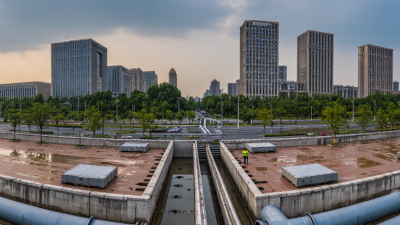
For global buyers, drainage sizing starts with peak flow, not guesswork. Use the Rational Method: Q = C × i × A. The runoff coefficient reflects surface type, rainfall intensity comes from a local design storm, and area must be measured accurately. NOAA Atlas 14 supplies precipitation-frequency data for the United States, while WMO guidance supports location-specific rainfall analysis worldwide. Do not copy rainfall values between countries.
A 1–2% pipe slope means 10–20 millimetres of fall per metre. It usually improves self-cleansing and limits standing water, but it is not a universal rule. Check local plumbing codes and site constraints. For example, a 160-millimetre internal-diameter pipe at 1% slope may carry roughly 18 litres per second under full-flow assumptions, using Manning’s equation and a typical roughness coefficient of 0.013. That capacity can change with joints, sediment, partial flow, and installation quality. A 1,000-square-metre paved area, with C = 0.9 and 100 millimetres per hour rainfall, produces about 25 litres per second. The example exposes a problem: the pipe may be undersized.
Tip: Request the design storm, catchment area, runoff coefficient, pipe material, and hydraulic calculation before purchasing. Ask for internal diameter, not only nominal size. Review access points too; field teams often discover maintenance limits too late. A 2% slope sounds safer, yet excessive velocity can cause erosion or outlet damage. Reference: NOAA Atlas 14 and WMO Guidelines on Hydrological Forecasting.
The chart shows estimated full-flow capacity for circular pipes at 1% and 2% slopes. Values are calculated with the Manning equation using a roughness coefficient of n = 0.013. Select a pipe diameter whose capacity exceeds the expected peak flow, then allow for debris, inlet restrictions, partial flow, and future demand.
For global drainage projects, certified materials reduce uncertainty before pipes reach the trench. ISO 1452 covers PVC-U piping systems for water supply, drainage, and sewerage under pressure. ISO 4427 covers polyethylene systems for water supply and pressure sewerage. These standards address dimensions, performance, and testing requirements.
The UN World Water Development Report 2023 states that about two billion people lack safely managed drinking water. This pressure makes reliable infrastructure more important, especially in rapidly growing cities. Buyers should request the complete conformity document, not only a printed logo. Check the standard edition, product scope, pressure class, test method, and issuing laboratory. The certificate should match the exact pipe diameter and material grade.
Look closely.
On delivery, inspect permanent markings, wall thickness, batch numbers, and production dates. Compare them with the purchase documents. For PE pipes, verify the resin designation and pressure rating. For PVC-U, confirm the intended jointing method and temperature limits. ISO compliance does not automatically prove correct installation or long-term site performance. Storage also matters; sunlight, sharp stones, and poor stacking can damage otherwise compliant products.
A common weakness is trusting paperwork without tracing each batch. That choice is convenient, but not fully defensible. Independent testing can verify hydrostatic strength, dimensions, and joint performance before installation. The ISO standards provide a technical baseline; competent inspection turns that baseline into dependable drainage work.
10 Water Drainage Tips for Global Buyers
Roof drainage failures often begin with weak specifications, not defective materials. EN 12056-3 provides a structured method for sizing roof outlets, gutters, and rainwater pipes. It considers rainfall intensity, roof area, flow routes, and hydraulic capacity. Ask suppliers for calculation records, not only product dimensions. A 100 mm outlet is not automatically adequate.
Climate data demands caution. The World Meteorological Organization reported that weather, climate, and water-related hazards caused over two million deaths and USD 4.3 trillion in economic losses from 1970 to 2021. The IPCC also identifies heavier precipitation as a growing risk in many regions. Therefore, confirm the design rainfall value with local meteorological or building authorities. Imported assumptions can fail.
Specify emergency overflow paths, visible discharge points, and safe access for inspection. Keep outlets clear of leaves, packaging debris, and construction dust. Backflow protection also needs clear wording. EN 12056-4 addresses wastewater lifting systems and protection against surcharge conditions, while local codes may require additional backflow devices. Check the lowest drain connection, basement level, and flood exposure before selecting equipment.
Test the system during commissioning. Record water flow, outlet performance, alarms, and access conditions. Small details matter. A practical mistake is relying on a single test during dry weather. That proves little. Require maintenance intervals, replacement access, and compatible seals in the purchase specification. Availability may matter more than peak capacity.
Global buyers should audit drainage suppliers before comparing prices. A low quote can hide weak testing, unclear materials, or poor warranty support. Ask for a current ISO 9001 certificate and verify its scope, issuing body, and expiry date. A certificate alone is not proof.
Require pressure testing for pipes, channels, tanks, and connection points. The supplier should provide the test pressure, holding time, acceptance limits, and recorded results. Request photos showing gauges, sealed outlets, and product identification during testing. Match each report with the production batch shipped to your project. Small details matter.
A ten-year warranty must state what it covers. Check exclusions for installation errors, chemical exposure, freezing, and unauthorized repairs. Confirm the supplier’s response time, replacement process, and responsibility for transport costs. In practical sourcing, vague warranty language creates expensive arguments later. I once treated a warranty period as enough evidence. That was too simple. Review the supplier’s quality records, inspection staff, factory capacity, and complaint history. Ask for references from comparable drainage projects. Speak with the installer, not only the sales representative. Keep every certificate, drawing, test report, and email in one audit file. Some suppliers may resist detailed checks. That resistance deserves attention.
| No. | Audit Dimension | What Global Buyers Should Require | Recommended Evidence or Test | Practical Acceptance Benchmark | Buyer Risk Reduced |
|---|---|---|---|---|---|
| 1 | Quality Management System | Verify that the supplier operates a documented quality management system appropriate to the supplied drainage products. | Request a current ISO 9001 certificate, certification scope, issuing body, validity dates, and the latest surveillance-audit status. | The certificate should be valid, cover the relevant manufacturing activity, and match the legal entity shown on the purchase contract. | Inconsistent production, undocumented processes, and weak corrective-action control. |
| 2 | Material and Product Traceability | Require batch, lot, or production-date identification for pipes, channels, fittings, grates, seals, and coatings. | Review incoming-material records, batch labels, production logs, inspection reports, and retained samples where applicable. | Each shipment should be traceable from finished product back to its material batch and inspection record. | Difficult recalls, mixed material grades, and inability to investigate field failures. |
| 3 | Hydraulic Capacity | Confirm that the proposed system is sized for the project’s rainfall intensity, catchment area, slope, flow rate, and allowable water depth. | Request hydraulic calculations using the project design criteria, including flow assumptions, pipe or channel dimensions, and outlet restrictions. | Calculations should use the buyer’s local rainfall data and show compliance with the project’s specified design flow and safety margin. | Flooding, ponding, undersized outlets, and costly redesign after installation. |
| 4 | Pressure and Leakage Testing | For closed drainage or pressurized sections, define the test pressure, test duration, allowable pressure loss, and test medium before production approval. | Obtain signed pressure-test records showing calibrated equipment, test section, applied pressure, duration, temperature, and results. | Use the project specification or applicable local standard; no visible leakage and no result outside the agreed pressure-loss limit. | Hidden leaks, joint failure, water infiltration, and premature service interruption. |
| 5 | Dimensional Accuracy and Fit | Check internal diameter, wall thickness, channel width, grate dimensions, connection geometry, slope requirements, and tolerances. | Review approved drawings, inspection plans, calibrated measurement records, and pre-shipment dimensional reports. | All measured dimensions should fall within the tolerances stated on the approved drawing or purchase specification. | Installation delays, incompatible components, and unplanned site modification. |
| 6 | Load and Structural Performance | Match covers, grates, channels, and access components to the actual traffic, pedestrian, loading, and installation conditions. | Request structural calculations, classification evidence, test reports, and installation details for the specified load category. | The declared load rating must meet or exceed the project requirement, including the specified support and installation conditions. | Cracking, deformation, unsafe access covers, and liability exposure. |
| 7 | Weather, Chemical, and UV Resistance | Evaluate exposure to sunlight, freeze-thaw cycles, salt, wastewater chemicals, oils, cleaning agents, and soil conditions. | Review material technical data, compatibility charts, environmental test reports, and the supplier’s recommended operating limits. | The selected material and seal system should be documented as suitable for the project’s temperature and chemical exposure. | Brittleness, swelling, corrosion, seal deterioration, and reduced service life. |
| 8 | Installation and Maintenance Requirements | Require clear instructions for bedding, jointing, anchoring, access, cleaning, inspection, and replacement of wear parts. | Check installation manuals, maintenance schedules, approved method statements, spare-part lists, and training materials. | Documents should identify tools, tolerances, inspection points, cleaning intervals, and corrective actions for common failures. | Improper installation, blocked drainage, premature damage, and higher lifecycle cost. |
| 9 | Pre-Shipment Inspection and Packaging | Define inspection points before dispatch and protect products against impact, distortion, moisture, contamination, and incorrect labeling. | Use a signed inspection checklist, product photographs, packing list, quantity verification, and loading records. | Shipment quantity, markings, accessories, documentation, and visible condition should match the approved order. | Transit damage, missing components, customs delays, and installation stoppages. |
| 10 | Warranty and After-Sales Accountability | Negotiate a written warranty covering product conformity, defects in materials and workmanship, claim procedures, exclusions, and remedies. | Review the signed warranty, start date, service response time, replacement obligations, documentation requirements, and applicable law. | For long-life drainage infrastructure, target a clearly defined 10-year warranty where commercially and legally appropriate; confirm that installation and maintenance conditions are stated. | Unclear liability, rejected claims, unexpected replacement costs, and weak post-delivery support. |
Buyer note: Certification, testing, load ratings, hydraulic performance, and warranty duration should always be verified against the destination country’s regulations, the project specification, and the signed supply contract.